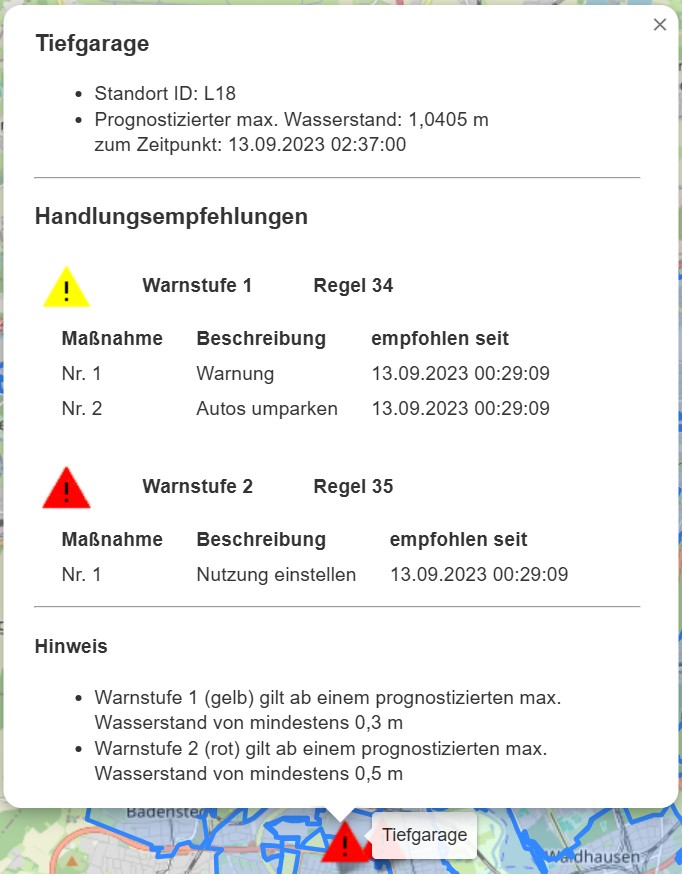
A knowledge base for countermeasures against stormwater hazards has been developed for the application scenario of Hanover. This knowledge base is applied within the framework of a Digital Twin that represents the various sub-areas of Hanover's drainage system in real time in an integrated manner in order to better manage the effects of extreme water events.
Taking the city of Hanover as an example, a Digital Twin has been developed which, based on real-time sensor data and simulation models, reflects the current state of the municipal sewage infrastructure along with its various sub-areas. By incorporating forecasts for key influencing factors such as rainfall and runoff data, it enables foresightful scenario analysis as a basis for proactive management of extreme rainfall events. The Digital Twin also provides operational staff at the sewage system with recommendations on how to handle heavy rainfall events in order, for instance, to reduce flooding damage within the city area and wastewater overflows into waterways.
These recommendations are based on detailed evaluations of freely available information on the internet as well as the analysis of surveys conducted with responsible parties involved in operating the sewer network and at the sewage treatment plants at Stadtentwässerung Hannover.
Through a map-based visualization, the developed Digital Twin presents to operational staff both the current and expected regional rainfall situation within the city area. It also highlights to technical operation staff at the treatment plants the resulting impacts across various sub-areas of the sewage system arising from current and anticipated rainfall.
Ultimately, the system offers municipal decision-makers recommendations for managing acute rainfall events (such as blocking transportation routes and streets, issuing warnings or notices, evacuating endangered properties, and securing them through local protective measures such as temporary flood barriers) as well as proactive preparations in anticipation of upcoming events (e.g., pre-emptive flushing of pumps).
The development of the knowledge base represents a new task for each city. However, due to its structured tabular format, the need for adaptation is moderate. The basic design can be largely adopted initially with analogies to be expected. It should also be noted that the entire system already functions effectively even if the knowledge base is not yet complete. Thus, the system grows along with the participating experts, and a joint learning process is systematically supported. The knowledge base also serves as a valuable tool for the comprehensive transfer of experience-based knowledge from senior staff just before retirement. This is particularly important during times of skilled labor shortages and demographic changes within the context, for example, of disaster protection themes.