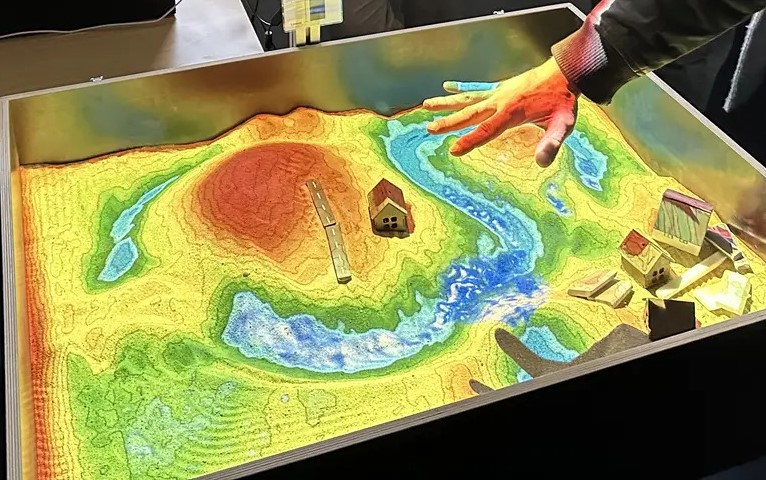
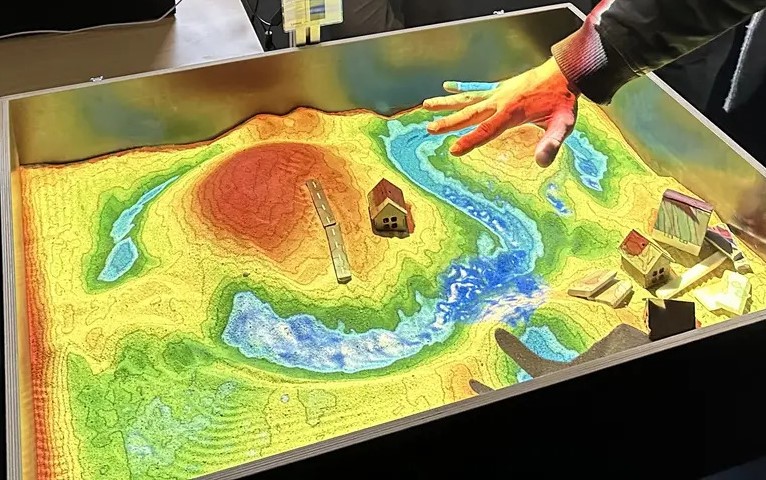
The AR Sandbox combines physical modeling with digital projection. Users shape landscapes with sand while a projector simulates water flows and hydrological processes. This interactive visualization promotes understanding of flood dynamics and protective measures, especially in educational and workshop formats.
Objectives:
• Teaching basic and application-oriented hydrological concepts (water flows, drainage routes, flood risks).
• Raising awareness of the importance of landscape design and preventive measures in the event of heavy rainfall.
• Promoting personal responsibility and active participation of citizens in heavy rainfall prevention
The interactive augmented reality (AR) sandbox combines real sand landscapes with digital visualization, enabling an intuitive understanding of how terrain characteristics influence water flow and what role they play in heavy rainfall prevention.
Height differences in the sand are detected by a camera and visualized in color.
As soon as a hand moves over the sandbox, digital precipitation is simulated. The virtual water flows over the shaped landscape and collects in depressions, valleys, or artificially created retention areas.
The sandbox was specially designed for educational and participatory contexts and has already been successfully used in workshops with schools, municipalities, and educational institutions. Whether children, young people in schools, or adults, the sandbox is suitable for all age groups. It invites participants to shape landscapes themselves, observe water flows and danger spots, and learn how to prevent them. The aim is for participants to develop their own creative ideas. This concept thus enables effective awareness-raising and involvement of citizens in heavy rain prevention. The combination of interactive simulation, group work, and everyday transfer creates a practical and engaging learning experience that can be directly transferred to local prevention. The concept was originally developed by REED et al. (2014) and adapted in the FloReST project for the specific requirements of heavy rain prevention.
Are you interested in using the sandbox in the field of environmental education?
Feel free to contact our FloReST project team at the Birkenfeld Environmental Campus!