The interactive StoryMaps combine georeferenced data, images, texts, and videos to vividly convey heavy rainfall risks. They are suitable for both professionals and citizens alike, as they can be flexibly adapted to local conditions.
What are StoryMaps?
StoryMaps are an intuitive, web-based application that links geographic information with multimedia content. They enable narrative knowledge transfer, in which spatial data is supplemented by interactive maps and embedded in an understandable context. Users can navigate independently through different thematic sections and retrieve specific information.
Use of StoryMaps in FloReST
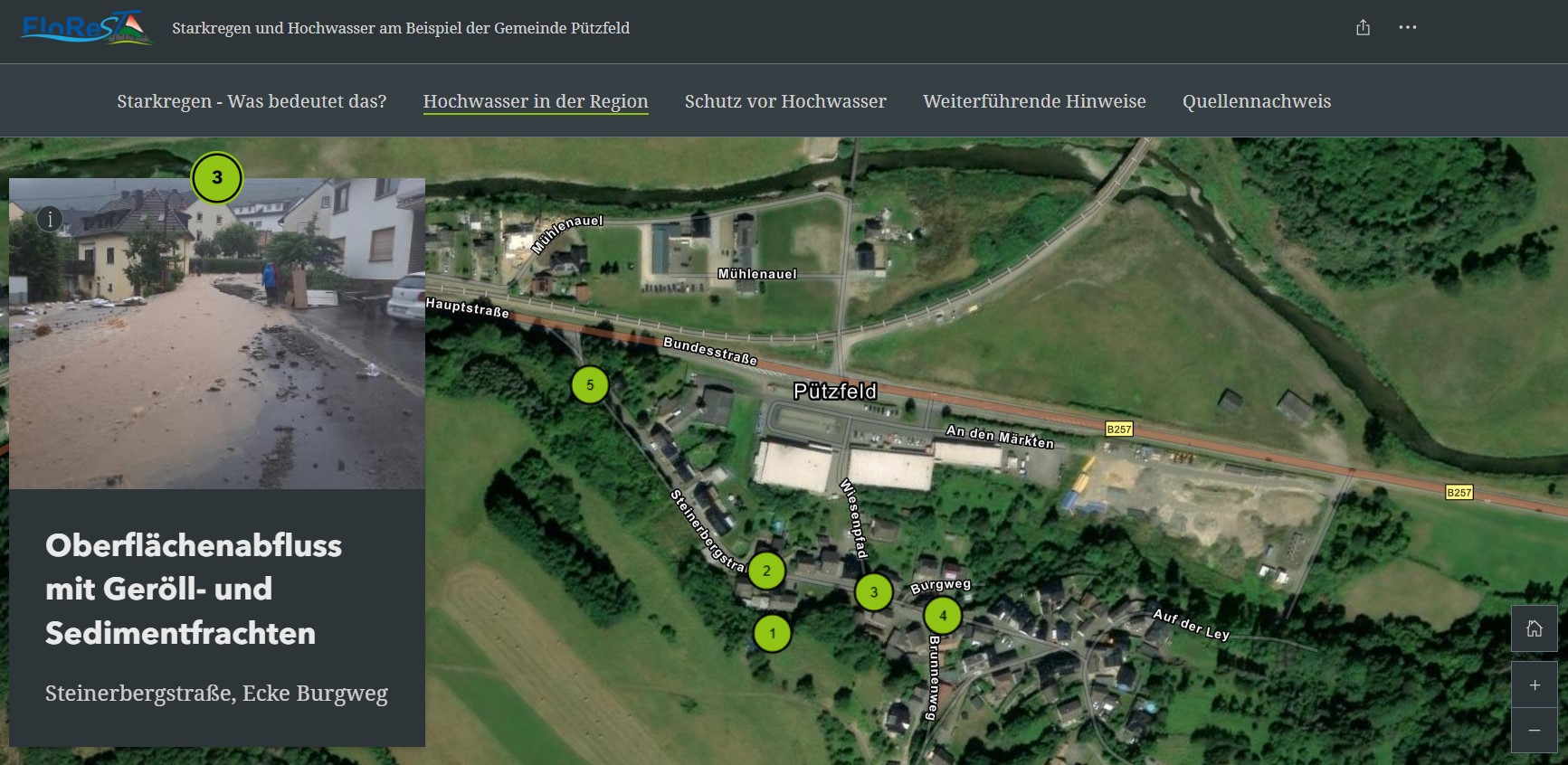
Extreme weather events such as heavy rainfall pose an increasing challenge for cities and municipalities. Effective communication of risks and possible protective measures is therefore essential in order to raise awareness of the issue among citizens and municipal stakeholders and prepare them for future events. At the Birkenfeld Environmental Campus, innovative ways of making risk communication interactive and target group-oriented were tested as part of the BMBF project FloReST (Urban Flood Resilience – Smart Tools). StoryMaps were developed to visualize past heavy rainfall events and to present preventive measures. One example is the StoryMap on heavy rainfall and flooding in the municipality of Pützfeld, which uses real data to show which regions are particularly at risk and how citizens can contribute to risk reduction.
The StoryMap integrates:
- Historical heavy rainfall events with interactive timelines and maps
- Detailed hazard maps for identifying areas at risk of flooding
- Practical recommendations for individual and municipal precautions
- Multimedia content such as image galleries and videos for illustrative knowledge transfer
Why use StoryMaps for risk communication?
Traditional sources of information such as PDFs or static websites often receive limited attention. StoryMaps, on the other hand, enable interactive engagement with the topic of heavy rainfall by involving users more deeply through visual and narrative elements. This not only promotes understanding of the dangers of heavy rainfall events, but also facilitates the derivation of appropriate protective measures.