Back to the list

WICKIE: in-situ monitoring tool to measure groundwater recharge flux

#in-situ #In-situ monitoring #low-cost #groundwater recharge
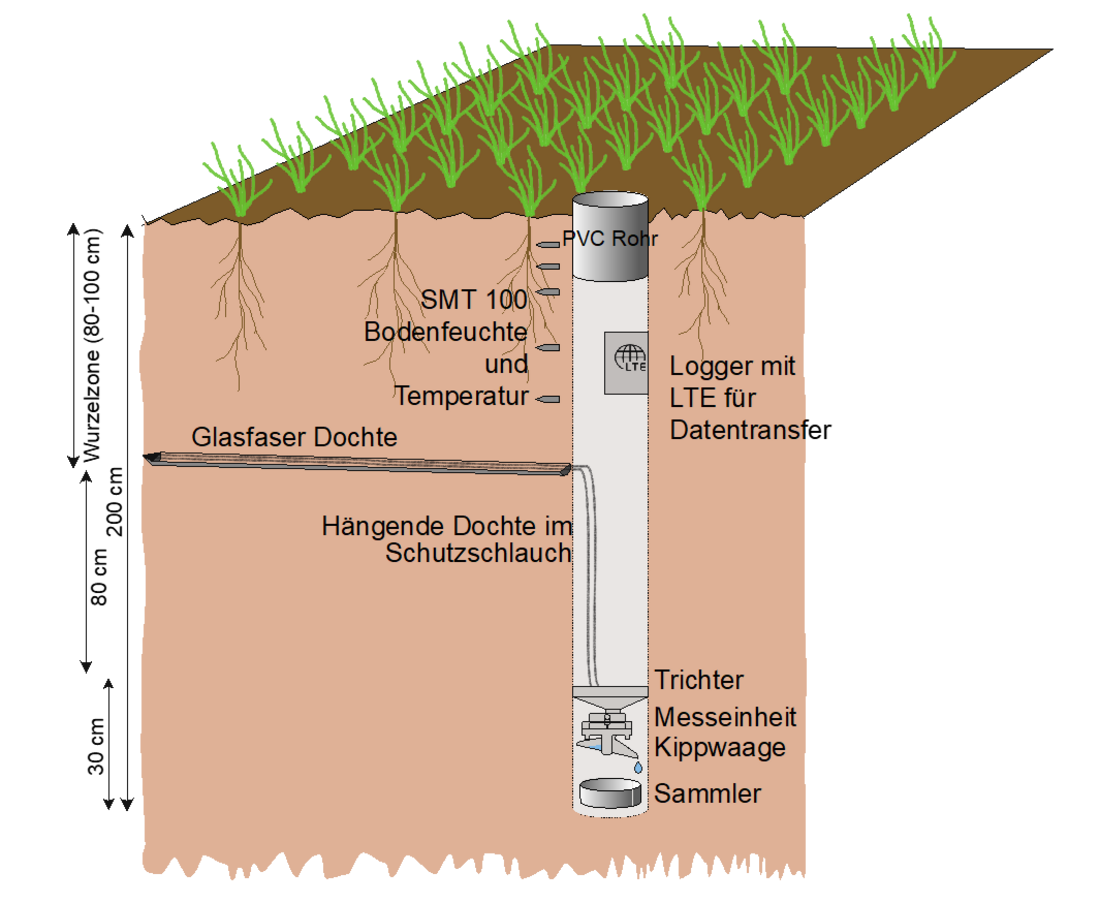
Schematic cross-sectional illustration of the WICKIE system for monitoring percolating soil water in agricultural land. Vegetation grows at the soil surface, with roots extending to a depth of approximately 80–100 cm. Below the root zone, a horizontal tray with fiber glass wicks collects percolating water and transports it through protected hanging wicks to a measurement unit located deeper in the soil profile. The measurement unit is installed in an access shaft and consists of a funnel, a tipping-bucket device for flow quantification, and a collection container. In the upper part of the soil, SMT 100 sensors measure soil moisture and temperature, while a data logger housed within the PVC tube with LTE connectivity enables wireless data transmission. The diagram illustrates the continuous collection of seepage water together with soil moisture and temperature monitoring in the subsurface.
Schematic setup of the WICKIE system, with fiber glass wicks below the root zone and access shaft holding the tipping-bucket, sampling bottle and data logger.

Innovative in-situ system for quantifying percolation volumes. WICKIE utilizes a combination of passive fiberglass wicks and a 3D-printed tipping bucket to capture water fluxes in real-time. Thanks to its unique geometry, it offers higher spatial representativeness than conventional samplers.

High-Resolution Groundwater Recharge Monitoring – Precise, low-cost, and Scalable

Accurately determining groundwater recharge and solute transport through the unsaturated zone is essential for environmental protection and sustainable agricultural management. Conventional lysimeters are often expensive, labor-intensive to install and maintain. WICKIE (WICK-sampler In-situ Estimations) provides a technological breakthrough to address these challenges.

The Innovative Concept:
WICKIE is a passive monitoring system that quantifies percolating water directly in the field. The core of the system is a stainless steel wick tray featuring eight linearly arranged fiberglass wicks. This design allows for the capture of greater lateral variability in soil water flux compared to standard square samplers.

Technical Highlights and Functionality:

  • Efficient Sampling: The hanging arrangement of the wicks creates a specific suction tension, drawing water from the surrounding soil without requiring an external power source for transport.
  • Precise Quantification: Collected water is routed through a 3D-printed PETG tipping bucket. Every tip is recorded as a discrete event, enabling extremely high-resolution capture of percolation events.
  • Disturbance free Installation: Thanks to the sharp leading edge of the rail, the system can be pushed horizontally into the soil. This preserves the natural soil structure and prevents the creation of artificial macropores.

Practical Application and Flexibility:
The system is modular and can be easily adapted to different soil and land-use types. By coupling it with battery-powered loggers and LTE-M modems, data is available in near real-time.

A key advantage is its extensibility: WICKIE serves as an ideal platform for integrating in-situ water quality sensors. This allows for the simultaneous capture of water flux and pollutant concentrations (e.g., nitrate or DOC), enabling the precise calculation of solute loads.

Whether in research, water resource management, or agriculture, WICKIE enables the cost-effective scaling of dense monitoring networks, contributing to the protection of vulnerable aquifers in intensively managed landscapes.

Water resource: Groundwater, Surface water
Type of product:
  • Monitoring & analytics
  • Technologies & processes
TRL: 7
    TRL (Technology Readiness Level)
  • TRL 1 - Basic principles observed
  • TRL 2 - Technology concept formulated
  • TRL 3 - Experimental proof of concept
  • TRL 4 - Technology validated in lab
  • TRL 5 - Technology validated in relevant environment (industrially relevant environment in the case of key enabling technologies)
  • TRL 6 - Technology demonstrated in relevant environment (industrially relevant environment in the case of key enabling technologies)
  • TRL 7 - System prototype demonstration in operational environment
  • TRL 8 - System complete and qualified
  • TRL 9 - Actual system proven in operational environment (competitive manufacturing in the case of key enabling technologies; or in space)
Application sector: Agriculture, Natural water environment, Water resource management
Funding measure: LURCH
Project: StressRes

Contact and partners


Logo Universität Freiburg, Hydrologie und Wasserforschung
  • Universität Freiburg, Hydrologie und Wasserforschung,
  • Friedrichstraße 39,
  • 79098 Freiburg
https://uni-freiburg.de/unr-hydro/
Heinke Paulsen
  • Heinke.paulsen@hydrology.uni-freiburg.de

Universität Freiburg, Hydrologie und Wasserforschung,
Freiburg