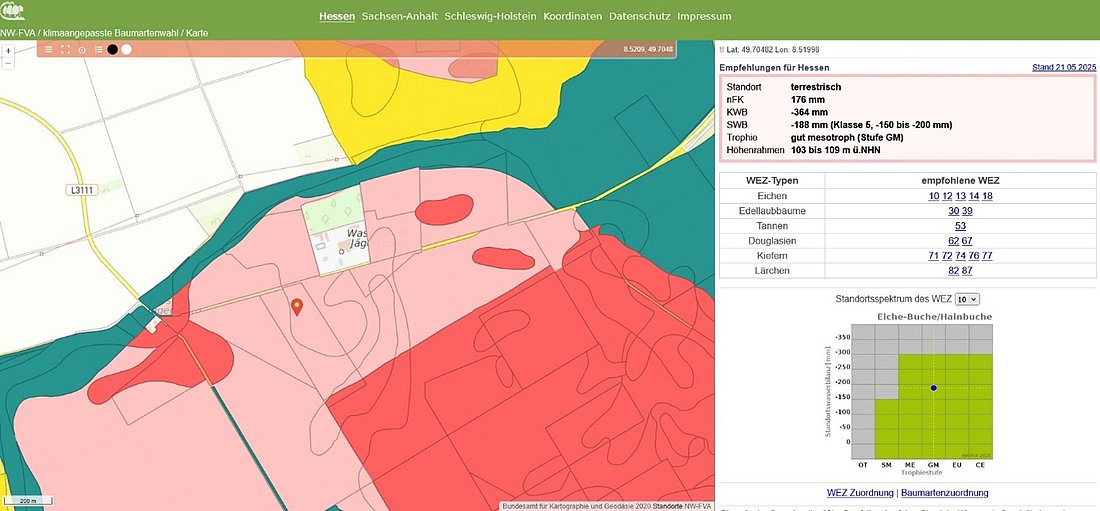
The goal of selecting tree species adapted to climate conditions is to ensure well-mixed, species-rich, and climate-resilient forests in the long term. Particular emphasis is placed on selecting tree species appropriate for the site, taking into account the site-productivity relationship and an assessment of abiotic and biotic risks. This expert analysis is offered as a web service and updated at regular intervals.
Climate change poses a particular challenge for the forestry sector, as the adaptive capacity of our tree species is expected to be exceeded in many areas. One silvicultural strategy for risk mitigation is the selection of site-appropriate tree species, which is of particular importance for the reforestation of damaged areas.
This is where the newly developed web service for climate-adapted tree species selection comes into play.
Based on the water balance of specific sites, the web service provides recommendations for climate-resilient tree species (or mixtures) that are considered resilient under future climate conditions. The web service is available for all privately and municipally owned forests in Hesse. Similar applications are also available for Saxony-Anhalt and Schleswig-Holstein. The risk of drought stress for sites free of groundwater and waterlogging is estimated using thresholds from the site water balance. This calculates the average of the climatic water balance during the growing season for a 30-year climate period against the soil’s usable field capacity. This allows for a forecast of how much water will be available to trees under changing climate conditions and at which sites they are likely to suffer from drought stress. The effects of changing climate conditions on forest growth and other risks are considered separately.
The recommendations are provided for each site as “forest development goals”