Wasserbedarf+ delivers calibrated, daily drinking-water demand forecasts for municipalities, combining calendar data, temperature, and population trends. Validated over 8 years with an average annual error of only ~3.3%, it supports capacity planning, drought readiness, and climate adaptation in water utilities.
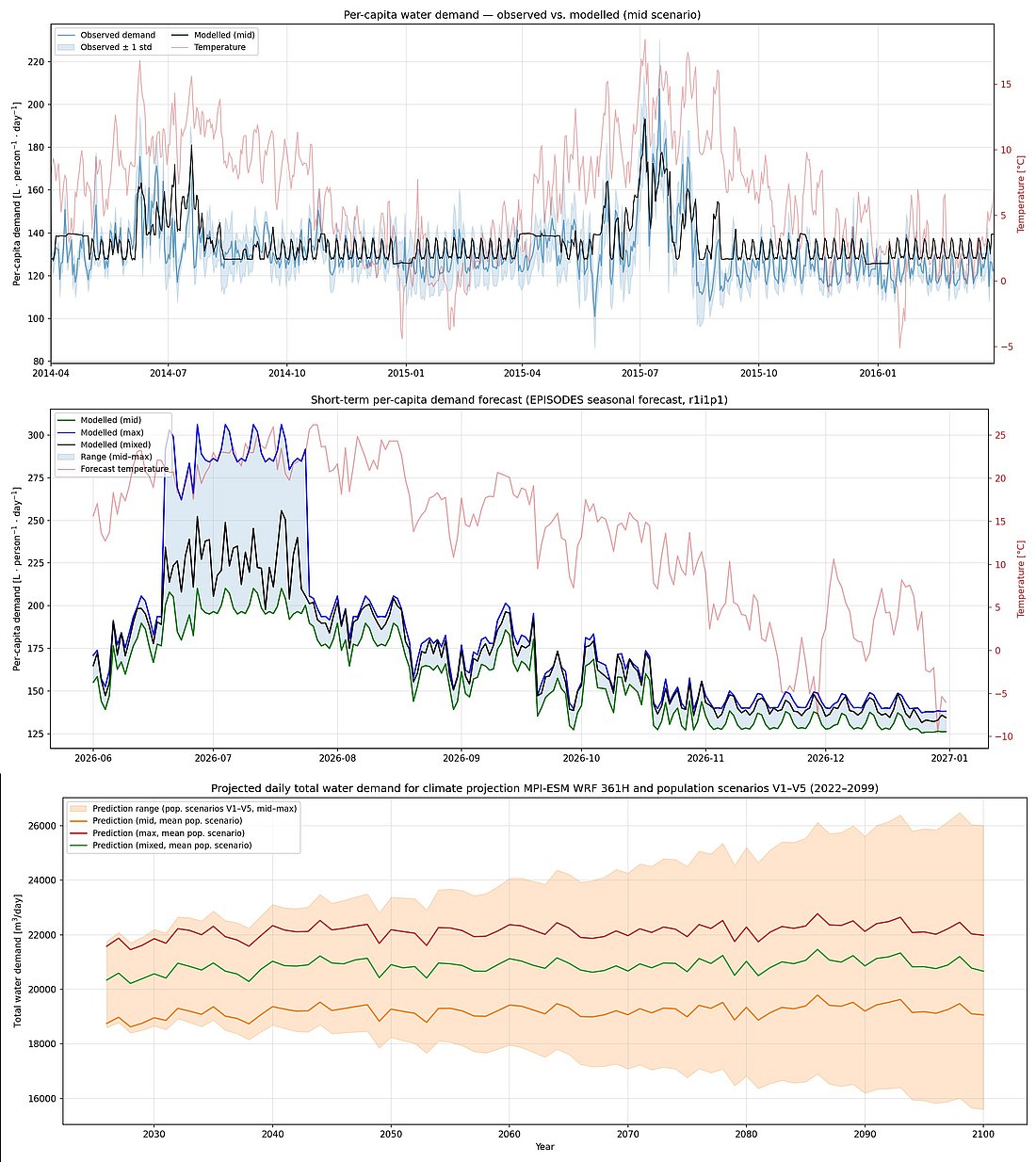
Wasserbedarf+ estimates daily per-capita and total drinking-water demand for municipalities by combining calendar dates, temperature (measured, forecast, or climate-projected), and population trends. It is built on a thorough analysis of historical consumption data: per-capita demand proved to be the most informative parameter, since it is independent of population size and correlates strongly with day of week, time of year, holidays, and average temperature. Other weather variables added little explanatory value, so the model was deliberately kept lean.
The model is structured in five layers: a calendar-aware seasonal baseline distinguishes normal periods, the pre-summer peak, summer holidays, gardening season, and the Christmas dip. Day-of-week and holiday factors refine this baseline for the specific date. A two-segment temperature-response curve — fitted with robust regression — scales demand up during heat and down during cold spells. Three planning scenarios are available: “mid” (expected value), “max” (peak-demand/stress test), and “mixed” (randomized blend within reasonable bounds, ideal for longer synthetic time series). Per-capita output is finally multiplied by population counts to obtain total daily demand.
The model's robustness was validated over 8 years (2014–2021) for the water providers in the study area of the GW 4.0 project (https://uni-tuebingen.de/de/244405): the mixed scenario reproduced actual annual demand within an average of 3.3% (best year: 0.3%, worst year: 7.8%), while the max scenario stayed within an average of 5.1% — a credible stress-test figure.
Wasserbedarf+ delivers an innovative, straight-forward, and sound tool for municipalities to estimate drinking water demand, provided that demand is not dominated by major industrial water consumers. The tool requires historical data on water distribution, temperature, and population. In the context of seasonal planning, Wasserbedarf+ can help identify periods of high demand early on—such as during heatwaves and droughts. When combined with long-term temperature projections, it provides a basis for assessing the suitability of water supply infrastructure.
Wasserbedarf+ was used in the GW 4.0 project—part of the "Sustainable Groundwater Management" (LURCH) funding initiative—to estimate the groundwater abstractions expected to be required on both a seasonal and long-term basis.