Back to the list

Remediation System: “PFAS Adaptive Mobilisation and Capture”

#PFAS #groundwater #Remediation #Mobilisation #Sorption
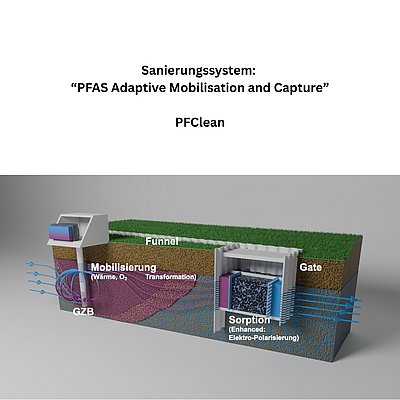
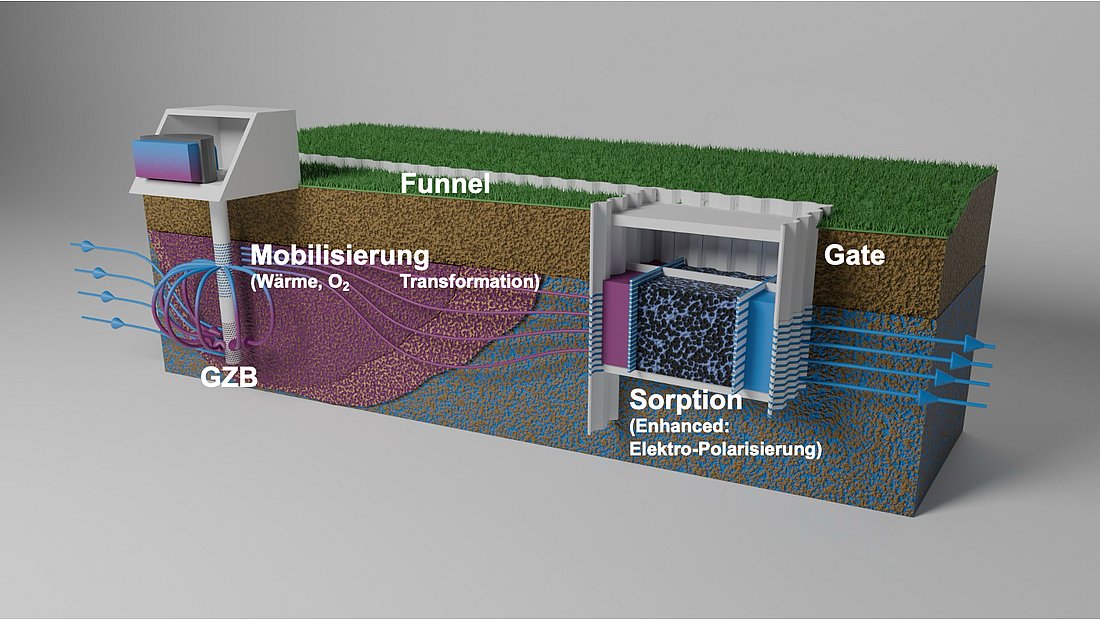
Shown are two components of the modular system to extract PFAS from the environment (PFClean): i) the „adaptive mobilisation“ part, where long-chain, immobile (precursor) substances are mobilized into shorter-chain, more mobile substances with the help of a groundwater circulation well (GZB); and ii) a „funnel & gate system in which PFAS are being adsorbed. The adsorption is improved with electric polarisation.
Shown is a schematic with two components of the modular system to extract PFAS from the environment (PFClean): i) the „adaptive mobilisation“ part, where long-chain, immobile (precursor) substances are mobilized into shorter-chain, more mobile substances with the help of a groundwater circulation well (GZB); and ii) a „funnel & gate system in which PFAS are being adsorbed. The adsorption is improved with electric polarisation.

The two components „PFAS Adaptive Mobilisation“ und „Electric Force Sorption“ are part of the modular system to extract PFAS from the environment (PFClean): i) the „adaptive mobilisation“ part, where long-chain, immobile (precursor) substances are mobilized into shorter-chain, more mobile substances with the help of a groundwater circulation well (GCW); and ii) a „funnel & gate system in which PFAS are being adsorbed. The adsorption is improved with electric polarisation.

PFAS are a large group of persistent, ubiquitous, and partly toxic substances („chemicals of emerging concern“). The two systems „PFAS Adaptive Mobilisation“ and „Electric Force Sorption“ enable the extraction of PFAS from the subsurface environment.

With the help of a GCW the environmental conditions in the aquifer were adapted such that microbially mediated transformation processes are enhanced. These processes transform longer-chain and immobile (precursor) substances into shorter-chain and mobile substances. This was achieved by adding heat and oxygen in the GCW and mixing them in the aquifer.

The sheet piles of the „funnel“ guide the groundwater flow towards the „gate“. In the gate, there is sorbent material (activated carbon) to which PFAS adsorb and subsequently can be extracted from the environment. So far activated carbon was known to be not efficient for retaining short-chain PFAS. By applying an electrical voltage, this disadvantage was eliminated. When the polarity is reversed, a highly concentrated  eluate is being released that is well suited for subsequent treatment.

The system was realized close to ground surface in an urban, closely built environment. The space requirements were small, all of which is a typical challenge at contaminated sites. Additionally, the sorbent material in the gate can easily be exchanged. The pilot site in Reilingen is the first site, where both systems were successfully used, according to our knowledge.  The PFAS concentrations in groundwater, as well as temperatures and oxygen levels were monitored in detail.

Water resource: Drinking water, Groundwater
Type of product:
  • Management concepts & assessments
  • Monitoring & analytics
  • Technologies & processes
TRL: 6
    TRL (Technology Readiness Level)
  • TRL 1 - Basic principles observed
  • TRL 2 - Technology concept formulated
  • TRL 3 - Experimental proof of concept
  • TRL 4 - Technology validated in lab
  • TRL 5 - Technology validated in relevant environment (industrially relevant environment in the case of key enabling technologies)
  • TRL 6 - Technology demonstrated in relevant environment (industrially relevant environment in the case of key enabling technologies)
  • TRL 7 - System prototype demonstration in operational environment
  • TRL 8 - System complete and qualified
  • TRL 9 - Actual system proven in operational environment (competitive manufacturing in the case of key enabling technologies; or in space)
Application sector: Cities and municipalities, Natural water environment, Water resource management
Funding measure: LURCH
Project: PFClean

Contact and partners


Logo Universität Stuttgart, Versuchseinrichtung zur Grundwasser- und Altlastensanierung (VEGAS)
  • Universität Stuttgart, Versuchseinrichtung zur Grundwasser- und Altlastensanierung (VEGAS),
  • Pfaffenwaldring 61,
  • Stuttgart
https://www.iws.uni-stuttgart.de/vegas/
PD Dr.-Ing. Claus Haslauer
  • vegasinfo@iws.uni-stuttgart.de
  • +49 711 685 64717

Universität Tübingen, Geo- und Umweltforschungszentrum,
Tübingen
Arcadis,
Amsterdam, Niederlande
Sax und Klee,
Mannheim
Geiger Entsorgung,
Oberstdorf

Media library


You might also be interested in