Many wastewater treatment plants are currently being expanded to a fourth treatment stage in order to remove micropollutants. The aim of the CatMemReac project was to reduce the CO2 footprint of this water treatment step. This is achieved by replacing energy-intensive micropollutant oxidation processes with sunlight-driven photocatalysis. (Project-ID: 02WIL1605)
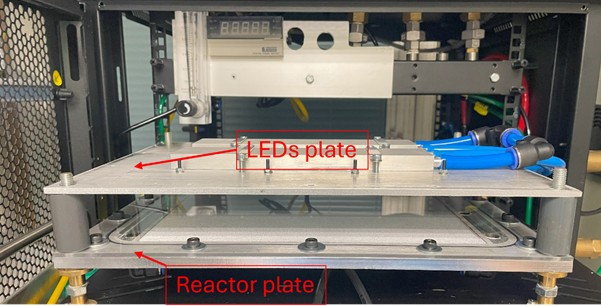
CatMemReac is a hybrid system that combines photocatalysis with upstream low-pressure membrane filtration in a compact design. The photocatalysis-based advanced oxidation process (AOP) is catalyzed by sunlight and solar-powered light-emitting diodes (LEDs). In this way, harmful trace substances such as the drug carbamazepine can be eliminated without leaving any residue.
For photocatalytic degradation, novel materials, such as heterogeneous nanocatalysts and metal foams with low life cycle costs, are used in eco-efficient processes with low energy requirements to reduce the carbon footprint of conventional water treatment processes.
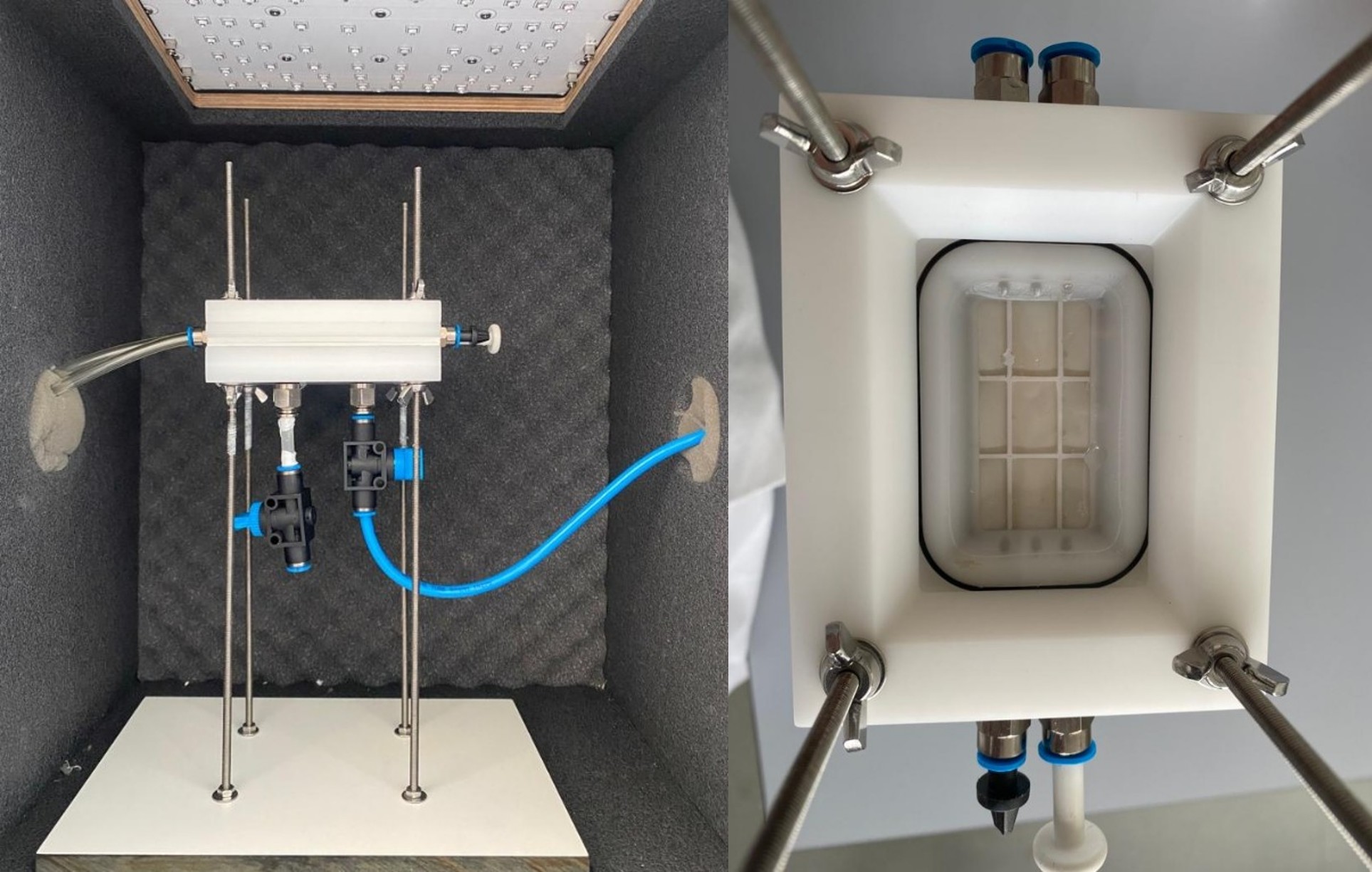
The materials were tested at Fraunhofer IGB in customized laboratory-scale photoreactors to gain access to dimensionless process parameters. On this basis, the performance of different systems could be objectively compared so that an optimized concept for scale-up could be identified.
The next step was the construction of a pilot-scale demonstrator plant for use in an on-site wastewater treatment plant in Israel in 2023. The experimental data collected from this real-life application was used to carry out a life cycle analysis with a focus on the carbon footprint. From this, a GWP of 2.2 kgCO₂eq/m³ was calculated for the best-case scenario on an industrial scale for the CatMemReac technology.
Even without the material technology improvements expected in the coming years, the CatMemReac reactor shows only slightly higher greenhouse gas emissions compared to conventional processes. The use of the technology for decentralized treatment for water purification and reuse can therefore be recommended as soon as the untapped potential for increasing efficiency is increased by a factor of about 8. Even before then, advantages in the scalability of operating conditions and handling, which constrain competing technologies such as ozonation, must be taken into account.