As part of the interdisciplinary DryRivers project, an approach for a holistic low flow risk analysis was developed and implemented in the LoFloDes software tool. The low flow risk analysis creates information about all aspects of low flow events and combines them into a risk value, thereby supporting a low flow risk management.
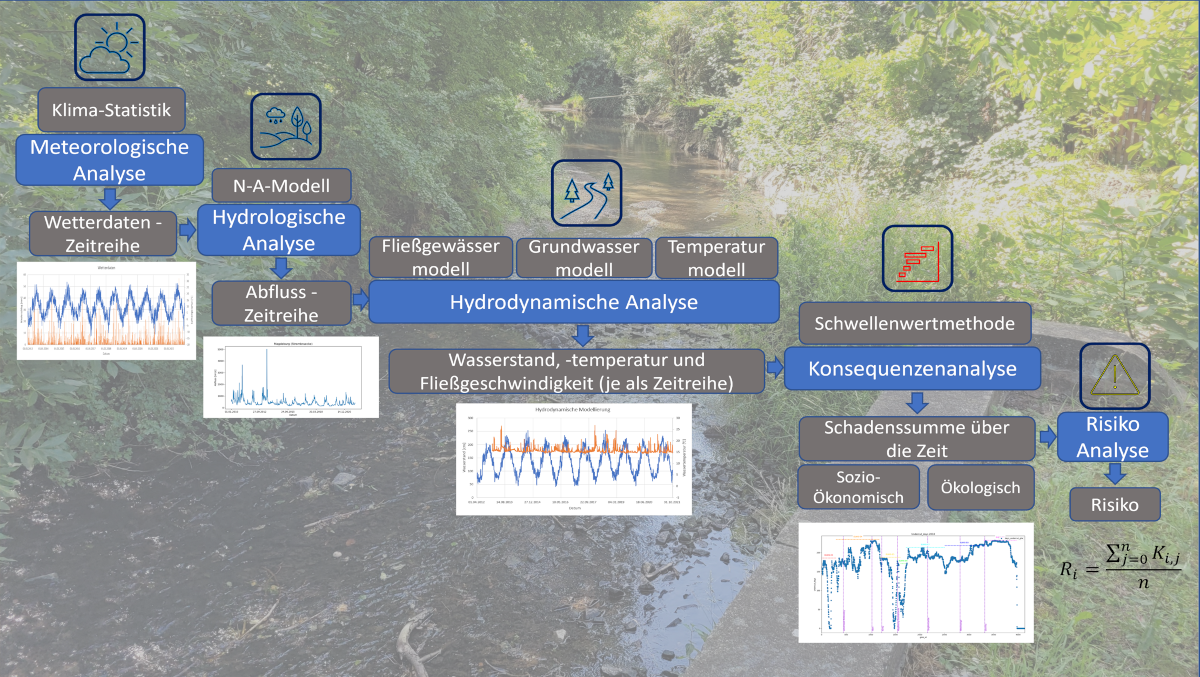
The approach developed for holistic low flow risk analysis comprises various base analyses. These range from the origin of low flowr (meteorological and hydrological analysis) to its run-off in the river (hydrodynamic analysis) and consequences (consequence analysis). The approach presented here is characterised by the modelling of long-term synthetic time series, whereby a scenario generation is evaded. The time series are generated in the weather generator, which derives statistics based on observed weather data from a specified period (e.g. 1990 to 2020) and use these to create the long-term synthetic series. As part of the hydrological analysis, long-term discharge time series are generated using precipitation-runoff modelling, which serve as input data for hydrodynamic modelling. Hydrodynamic modelling is used to calculate the water depth, flow velocity and water temperature along the river. Based on these results, the consequences of low flow events are analysed, determining both ecological consequences (e.g. to fish or macrozoobenthos) and socio-economic consequences (e.g. for shipping, hydropower or water abstraction). Finally, the damage is added up and divided by the number of years modelled, resulting in a low flow risk. Based on the results, an assessment of the vulnerability of the river can be made; mitigation measures can be developed and evaluated accordingly. Further information can be found in the attached publication.
The Low-Flow Risk Decision Support software tool (LoFloDes) has integrated some of the required basic analyses, while others are linked to existing scripts to perform the low flow risk analysis described above in a semi-automated manner.