Back to the list

Low-cost nitrate and DOC sensor for natural water samples

#nitrate #DOC #In-situ monitoring #monitoring
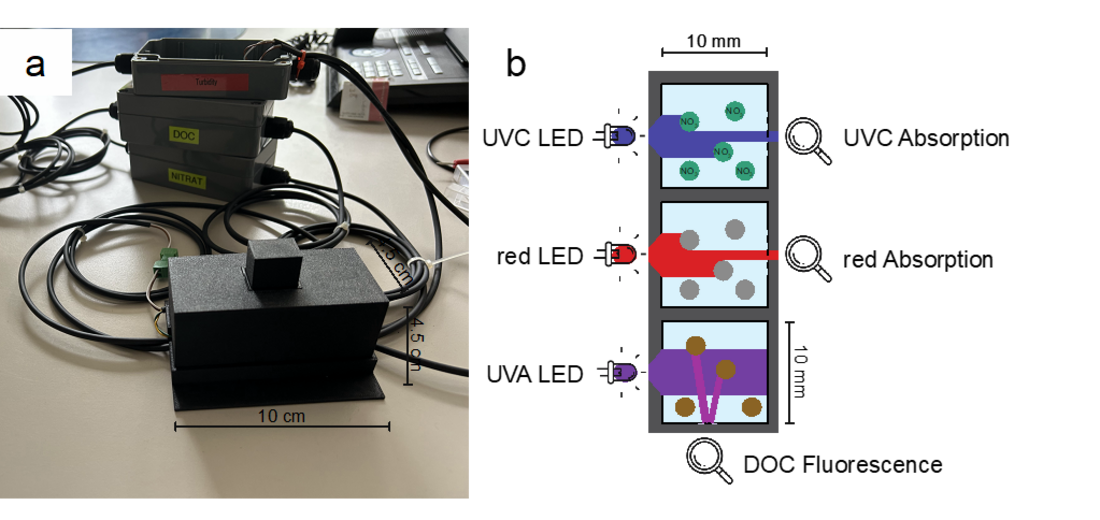
The figure consists of two panels. On the left (a), a photograph shows a modular sensor system placed on a laboratory bench. The setup comprises three stacked modules connected by cables and labeled “Nitart,” “DOC,” and “Turbidity.” In front of the module stack is a black measurement housing with an opening on its top surface. Scale markings indicate a housing width of approximately 10 cm and a height of about 4.5 cm. On the right (b), a schematic diagram illustrates the modular measurement setup with three vertically arranged sensing chambers, each approximately 10 mm wide and high. The upper chamber is illuminated by a UVC LED and is used for measuring UVC absorbance. The middle chamber contains a red LED; a red light beam passes through the sample to determine absorbance in the visible range. The lower chamber is excited by a UVA LED, causing the sample to emit fluorescence that is detected perpendicular to the excitation path. Magnifying-glass symbols indicate the detection positions for UVC absorbance, red-light absorbance, and DOC fluorescence. The schematic illustrates the operating principle of a modular sensor for absorbance and fluorescence measurements.
Photograph of the setup (a) containing three modules and schematic drawing of the modular setup (b), showing the principles of absorbance measurement and fluorescence

Innovative in-situ measurement system for real-time water quality monitoring. Our sensor combines the determination of nitrate (NO3-) and dissolved organic carbon (DOC) in one compact, cost-effective housing. Ideal for continuous use in soil, ground, and surface waters – delivering low-cost data without time-consuming laboratory analysis.

Precision Water Analytics in Real-Time – Efficient, Compact, and Innovative

Monitoring nutrients and organic matter in aquatic environments is crucial for understanding ecological processes and protecting our resources. While traditional laboratory methods are precise, they are time-consuming and cannot capture rapid fluctuations in concentration. Our new optical multi-parameter sensor system solves this challenge.

By combining advanced spectroscopic principles into a single device, the sensor enables the simultaneous capture of three critical parameters:

  • Nitrate (NO3-​): Utilizing UVC absorption (235 nm), nitrate concentrations are determined quickly and non-destructively.
  • Dissolved Organic Carbon (DOC): Using UVA-induced fluorescence (375 nm) and intelligent algorithms (GAM/Linear models), DOC levels are calculated.
  • Turbidity/Particles: An integrated red-light sensor (650 nm) measures turbidity, which also serves to correct measurement errors caused by suspended particles.

What makes this system innovative:
Unlike expensive and complex spectrometers, our system employs a modular architecture using cost-effective LEDs and specialized detectors, such as silicon photomultipliers. The result is a system that matches the performance of high-end reference devices while requiring significantly less power and offering easier operation.

Practical Applications:
The system is specifically designed for field use. Thanks to its robust, 3D-printed housing and RS-485 interface, it can be seamlessly integrated into existing data logger networks. Typical applications include:

  • Agriculture: Monitoring nitrate leaching in soil water to optimize fertilization.
  • Hydrology: Continuous monitoring of streams and groundwater aquifers.
  • Environmental Protection: Early detection of pollutant peaks during heavy rain events.

With high correlation rates (R2R2 up to 0.94 for DOC), the system provides a reliable alternative to discrete sampling and enables dynamic in-situ analysis of water chemistry.


Water resource: Groundwater, Surface water
Type of product:
  • Monitoring & analytics
  • Technologies & processes
TRL: 4
    TRL (Technology Readiness Level)
  • TRL 1 - Basic principles observed
  • TRL 2 - Technology concept formulated
  • TRL 3 - Experimental proof of concept
  • TRL 4 - Technology validated in lab
  • TRL 5 - Technology validated in relevant environment (industrially relevant environment in the case of key enabling technologies)
  • TRL 6 - Technology demonstrated in relevant environment (industrially relevant environment in the case of key enabling technologies)
  • TRL 7 - System prototype demonstration in operational environment
  • TRL 8 - System complete and qualified
  • TRL 9 - Actual system proven in operational environment (competitive manufacturing in the case of key enabling technologies; or in space)
Application sector: Agriculture, Natural water environment, Water resource management
Funding measure: LURCH
Project: StressRes

Contact and partners


Logo Universität Freiburg, Hydrologie und Wasserforschung
  • Universität Freiburg, Hydrologie und Wasserforschung,
  • Friedrichstraße 39,
  • 79098 Freiburg
https://uni-freiburg.de/unr-hydro/
Heinke Paulsen
  • Heinke.paulsen@hydrology.uni-freiburg.de

Truebner GmbH

Media library