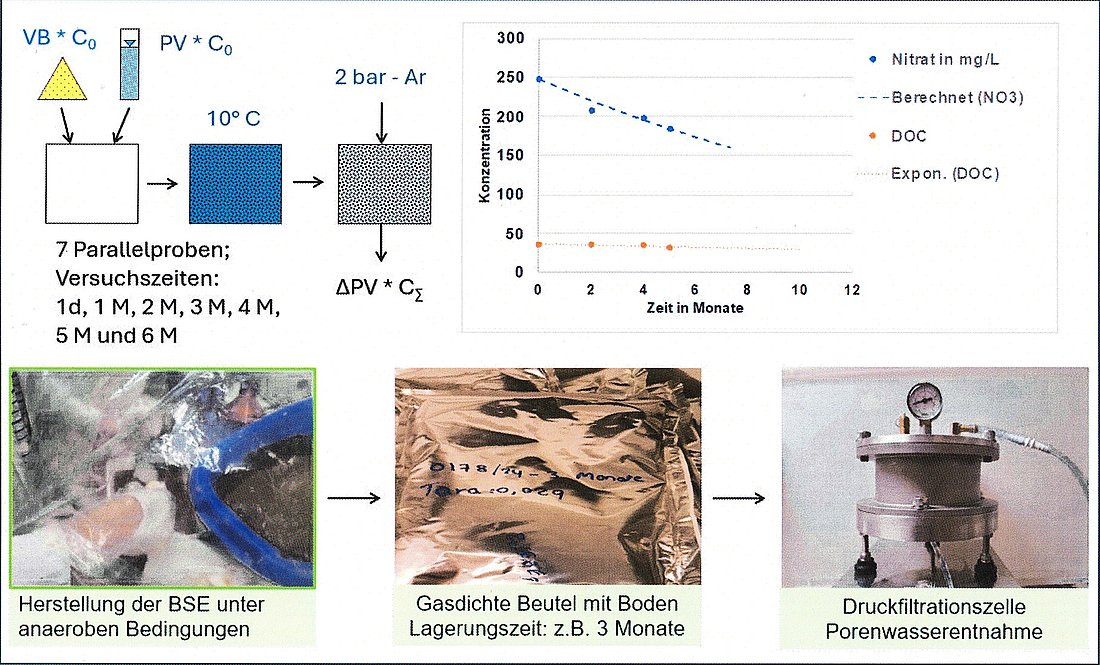
Laboratory methods for quantifying denitrification rates and microbial degradation rates in soil and groundwater, taking into account various environmental conditions (partially saturated/saturated) and maintaining near-natural conditions (texture, environmental conditions, and moisture content).
Laboratory methods for quantifying denitrification rates and microbial degradation rates in soil and groundwater, taking into account various environmental conditions (partially saturated/saturated) and maintaining near-natural conditions (texture, environmental conditions, and moisture content). In conjunction with simulation models for predicting substance transport in soil and groundwater, the results enable a reliable prediction of the spread of contaminants or substances in soil and groundwater in accordance with the Federal Soil Protection Ordinance (BBodSchV) and the Drinking Water Catchment Area Ordinance, including for trace substances, regardless of the Darcy permeability coefficient (kf value). Thus, the results can be used to support regulatory decisions regarding risk assessments, including any resulting preventive or remediation measures, and the determination of permissible substance inputs (substance loads) that prevent the exceedance of target values at the site of interest or for the protected resource or object. Examples include: historical contamination, historical deposits, agricultural fertilizer consulting; backfilling of mining excavations; Monitored Natural Attenuation. Another application involves the plausibility check of numerical reactive models for simulating contaminant transport using PHREEQC