Back to the list

In situ: PFAS SorpCarpet – Immobilization on Agricultural Land

#PFAS #soil #Remediation #Immobilisation
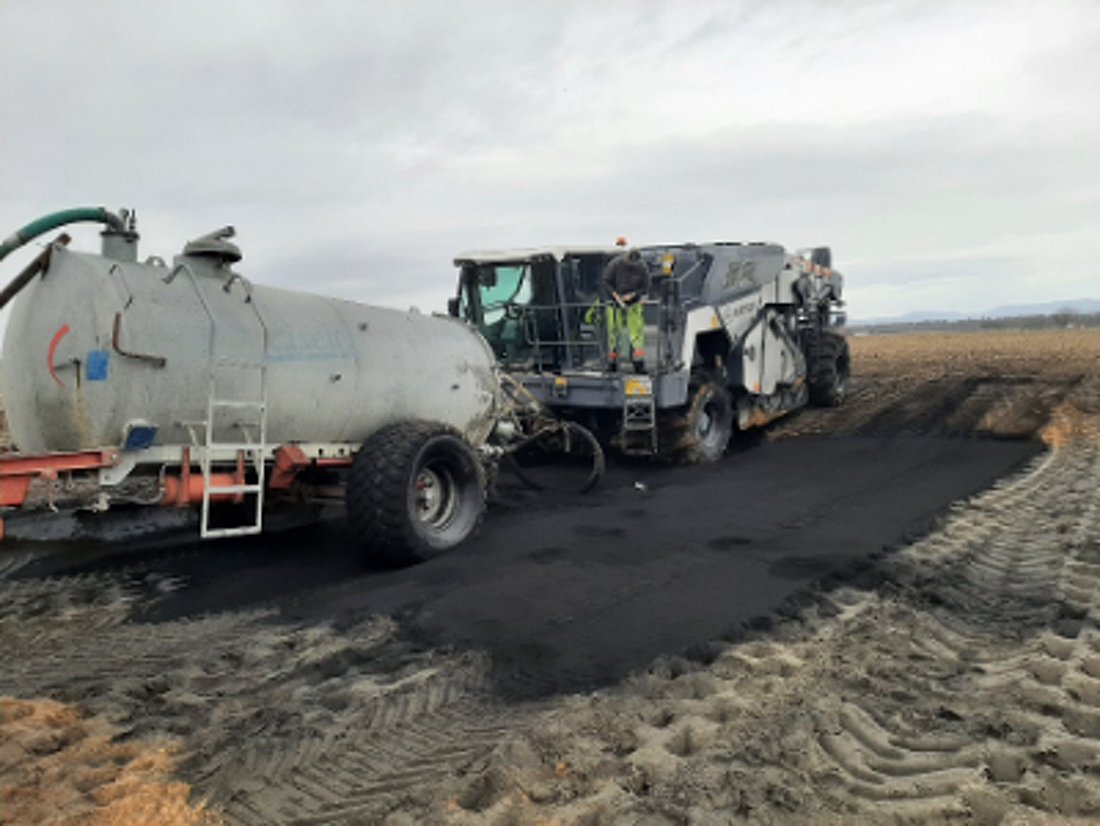
With technical equipment, a defined mass of sorbent per square meter and a defined volume of water (via a tank-trailer) per square meter is added and well mixed into the soil.
Mixing of sorbent and water into PFAS contaminated soil.

PFAS have long half-lives of decades to centuries. For example, in the Rhine Valley, a very large fraction of the PFAS mass, applied more than 15 years ago, sits still in the very topsoil (few decimeters). Without treatment, this contaminant mass would reach deeper sections of the subsurface, the groundwater, and drinking water- and irrigation wells. PFAS SorpCarpet inhibits this while agriculture is ongoing.

The sorbent was selected among commercially available substances considering the characteristics of the pilot site and its optimal mass fraction determined. Within the research project „PFClean“ we tested about 10 sorbents and selected the one with the best retention capacity.

We also tested a technology for mixing the activated carbon uniformly with the soil, specifically a defined mass of sorbent per square meter and a defined volume of water per square meter for the activation of the sorbent. The SorpCarpet was emplaced below the organic rich topsoil and below the predominant PFAS-containing soil section. The preservation of the topsoil was a high priority, as agricultural land-use was ongoing (e.g. seed corn was cultivated on the pilot site).

Whereas many PFAS contaminated sites are point-sources, there are a number of non-point sources, e.g. from material from the paper industry that was applied on agricultural land. For such sources, PFAS SorpCarpet is especially well suited, as it preserved the organic rich top soil at the pilot site in Hügelsheim.

This is the first pilot site for PFAS immobilization in Germany, according to our current knowledge. The PFAS concentrations in the porewater below the SorpCarpet decreased during the project to very low numbers. Together with a reduced infiltration rate this resulted in a meaningfully reduced mass flux. Hence, the resource groundwater can be protected well from the long-term PFAS sources, and agricultural practices did continue.

Water resource: Drinking water, Groundwater
Type of product:
  • Management concepts & assessments
  • Monitoring & analytics
  • Technologies & processes
TRL: 6
    TRL (Technology Readiness Level)
  • TRL 1 - Basic principles observed
  • TRL 2 - Technology concept formulated
  • TRL 3 - Experimental proof of concept
  • TRL 4 - Technology validated in lab
  • TRL 5 - Technology validated in relevant environment (industrially relevant environment in the case of key enabling technologies)
  • TRL 6 - Technology demonstrated in relevant environment (industrially relevant environment in the case of key enabling technologies)
  • TRL 7 - System prototype demonstration in operational environment
  • TRL 8 - System complete and qualified
  • TRL 9 - Actual system proven in operational environment (competitive manufacturing in the case of key enabling technologies; or in space)
Application sector: Agriculture, Cities and municipalities, Natural water environment, Water resource management
Funding measure: LURCH
Project: PFClean

Contact and partners


Logo Universität Stuttgart, Versuchseinrichtung zur Grundwasser- und Altlastensanierung (VEGAS)
  • Universität Stuttgart, Versuchseinrichtung zur Grundwasser- und Altlastensanierung (VEGAS),
  • Pfaffenwaldring 61,
  • Stuttgart
https://www.iws.uni-stuttgart.de/vegas/
PD Dr.-Ing. Claus Haslauer
  • vegasinfo@iws.uni-stuttgart.de
  • +49 711 685 64717

Universität Tübingen, Geo- und Umweltforschungszentrum,
Tübingen
Arcadis,
Amsterdam, Niederlande
Sax und Klee,
Mannheim
Geiger Entsorgung,
Oberstdorf

Media library


You might also be interested in