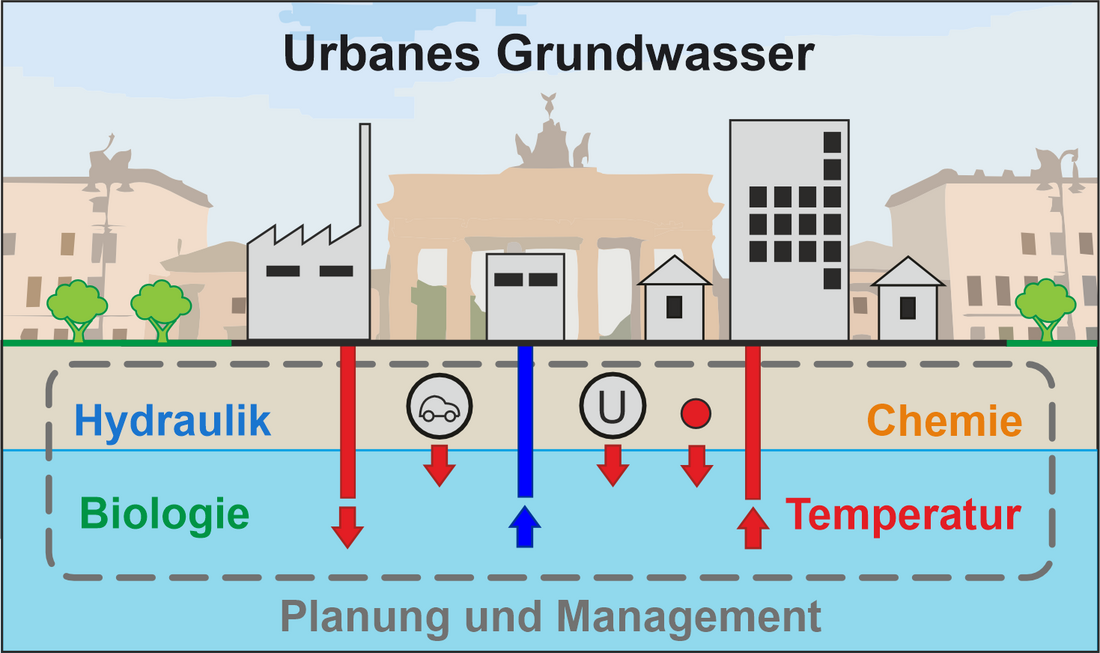
The CHARMANT project developed approaches for sustainable, thermo-hydraulic-ecological management of urban aquifers from hydrogeological as well as spatial planning perspective.
Groundwater in urban areas is characterized by small-scale spatial variability and short-term dynamics in its characteristics. Dense surface and subsurface use in such areas leads to potential conflicts between drinking water production, geothermal systems installations and the overarching aim of maintaining the quantitative and qualitative state of the groundwater. This highlights the need for prescient groundwater management and integrated planning of groundwater uses.
The first part of the policy recommendations is addressed to authorities (e.g. in cities or other communities), which are responsible for monitoring groundwater quality or permitting groundwater uses. It contains recommendations for physico-chemical and ecological groundwater monitoring in urban areas, as well as the assessment of oxygen levels in groundwater and habitat suitability for groundwater fauna.
The second part of the recommendation for spatial planners was developed mainly for the project sites in Berlin and Karlsruhe, where the analyses and stakeholder workshops were carried out. The shown approaches and strategies however are presented in way that ensures general transferability to similar planning instruments in other cities, regions and federal states. The analysis of the legal aspects encompassed European, federal and state-specific laws and regulations. Accordingly, recommendations are made for legal stakeholders at Federal and state level, as well as specifically for Berlin/Brandenburg and Baden-Württemberg.
Furthermore, recommendations are made for an effective active environmental communication on topics relating to groundwater in general and groundwater ecology specifically. Insights gained from the different participation concepts applied in CHARMANT (dialogs, networking events, citizen science approaches) were used to optimize event concepts and communications measures to boast knowledge exchange between the scientific community and society.