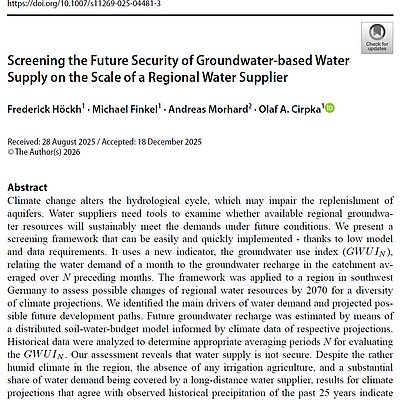
The Groundwater Use Index (GWUI) is a newly developed indicator that lets water suppliers quickly assess whether their groundwater resources will meet current and future demand. It relates monthly water demand to groundwater recharge averaged over several preceding months, making emerging supply shortages visible at an early stage.
Climate change and rising water demand raise the question of whether regional groundwater resources will remain sufficient in the future. Researchers at the University of Tübingen, together with GIT HydroS Consult GmbH, developed an easy-to-apply screening framework centred on a new indicator: the Groundwater Use Index (GWUI).
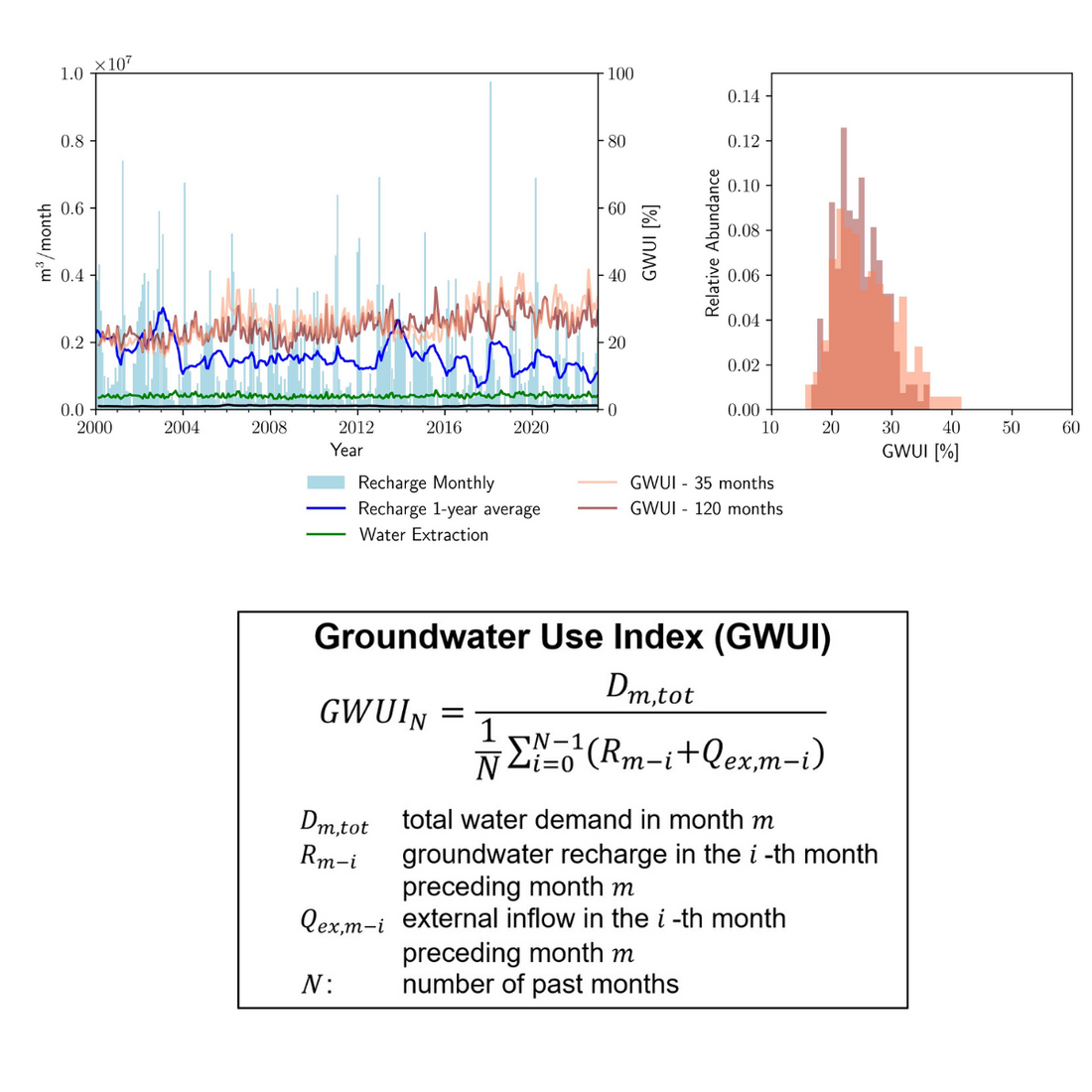
The GWUI relates the total water demand of a given month to the average groundwater recharge of the preceding N months in the catchment of the supply wells. By choosing the averaging period N, the index can be tuned to reveal either long-term trends (e.g. N = 120 months) or short-term stress peaks (e.g. N = 36 months), avoiding the need for costly transient groundwater-flow models.
The framework was applied to the regional water supplier Ammertal-Schönbuch-Gruppe (ASG) near Tübingen/Herrenberg (Baden-Württemberg, Germany), which supplies about 123,000 people. Using 20 years of operational data, the optimal averaging period (35 months) was identified and cross-checked against documented past supply constraints. Climate-model projections to 2070 show that even in a humid region long considered climate-resilient, recurring critical supply situations can occur despite support from a long-distance water supplier.
The method requires only a few, mostly readily available data sets (water delivery volumes, population figures, meteorological data, a soil-water-balance model) and can therefore be transferred to other water suppliers and regions with reasonable effort. It gives water suppliers, municipalities and water authorities a robust, easy-to-communicate metric for assessing supply security under present and future climate conditions – supporting investment and adaptation decisions.