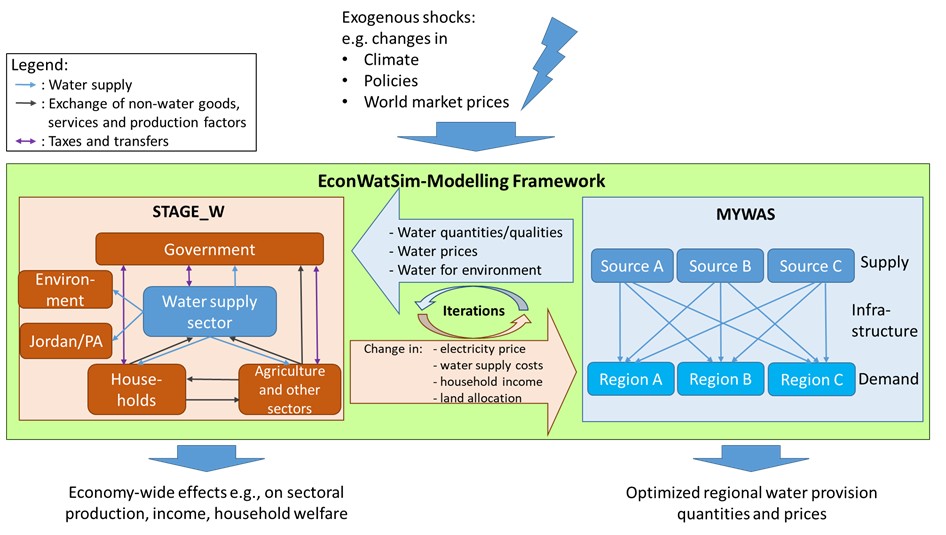
The integrated EconWatSim-Modelling Framework links a spatial water sector optimization model with an economy-wide model. It can be applied to the ex-ante assessment of a wide range of exogenous shocks such as policy changes within and beyond the water sector and provides detailed results for the water sector as well as for the wider economy.
The integrated Economic Water Simulation (EconWatSim) modelling framework consists of two interconnected modules: MYWAS (Multi-Year Water Allocation System), a water-sector optimization module that provides a detailed depiction of topography as well as water supply infrastructure and STAGE_W (STatic Applied General Equilibrium model focussed on Water), a computable general equilibrium model that captures the linkages between the water sector and the broader economy by representing all relevant economic agents such as households, firms, and the government, as well as their interactions on commodity and factor markets.
These modules are linked iteratively through the exchange of outcome variables. The framework depicts:
- a broad range of water management options (including various taxation schemes and cost recovery measures both within and outside the water sector),
- different water qualities and their corresponding provision costs, as well as
- non-revenue water (such as leakage, water reserved for nature, and water transferred to neighbouring entities).
The approach provides complementary perspectives in terms of a detailed and spatial representation of the water sector on the one hand, and an economy-wide perspective on the other hand. EconWatSim therefore allows for an in-depth welfare analysis at the household level, which could not be provided by the single model components alone, considering spatial heterogeneity as well as the fixed costs of water provision.
Thus, the integrated framework enables a more holistic assessment of the impacts of changes in the water sector and supports the design of coherent policies within the water–energy–food nexus, ultimately contributing to a more efficient, sustainable, and integrated management of scarce water resources. The modelling framework is formulated in a generic way such that it can be applied in different countries and to a wide set of policy questions.