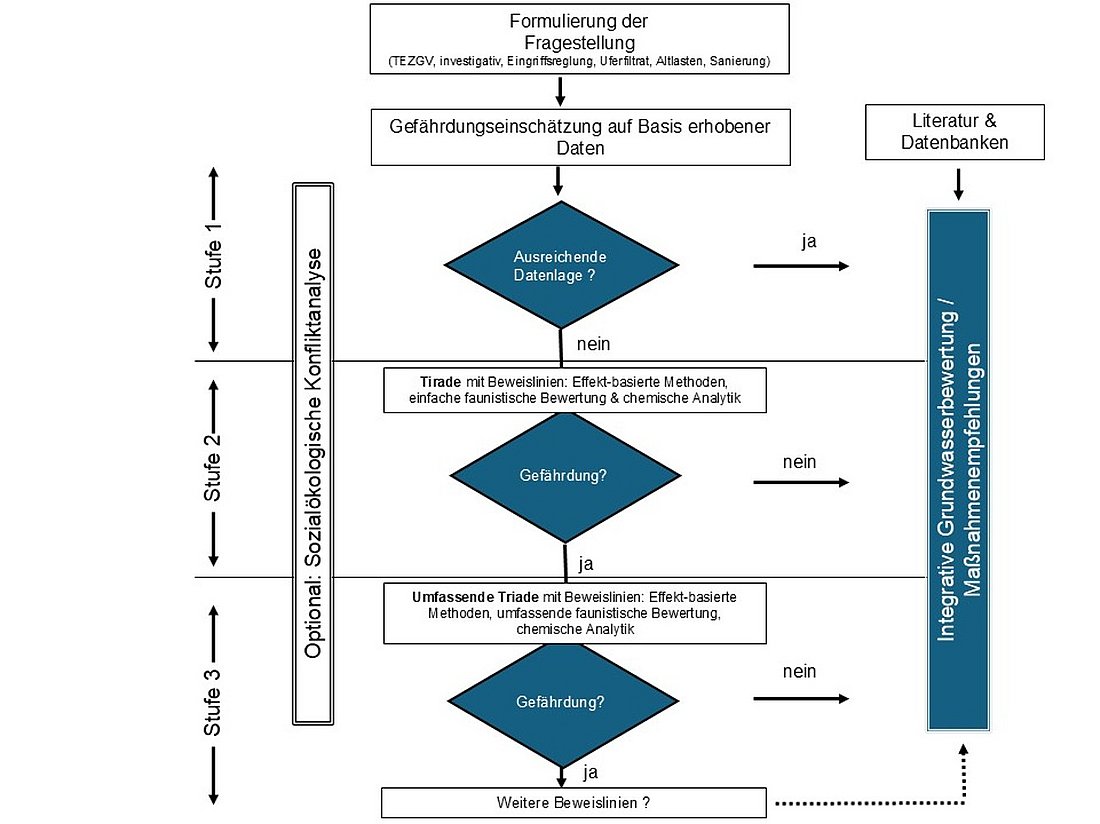
For a holistic groundwater assessment, a three-stage assessment model based on a triad approach is proposed, which integrates chemical, ecotoxicological and ecological aspects. A decision tree based on this model, designed to provide action recommendations, enables practical groundwater risk assessment and supports sustainable protection and management measures.
Under current legal practice, groundwater is treated merely as a resource under the WFD (WFD 2000/60/EC, 2000); it is not assessed for its ecological status and is therefore not protected as an ecosystem. Furthermore, the assessment of chemical status is limited to a few groups of pollutants, such as heavy metals and pesticides (GWRL 2006/118/EC), which do not capture the full complexity of trace-substance contamination in groundwater (Bunting et al., 2021). The applicability of a triad approach was examined for an integrated groundwater assessment model. The central principle behind this is to record and assess three lines of evidence: chemical exposure, ecotoxicological effects using a battery of bioassays, and ecological diversity.
To facilitate subsequent transferability into practical, integrated groundwater assessment, a multi-stage decision tree is being developed in collaboration with users as a recommendation for action. The first decision point, or the first stage, follows the risk assessment based on data already collected. If this is sufficient, recommendations for measures can be made directly. If the assessment is negative or the data is insufficient, the implementation of a simplified triad is recommended as the second stage: this comprises the lines of evidence from effect-based methods as a simplified battery of bioassays with a focus on cell-based biological effect tests; a simple faunal assessment based on Griebler et al. (2014), and targeted chemical analysis. If sufficient data is available and a risk to the ecosystem can be ruled out, recommendations for action can again be formulated. If a risk is identified, implementing the third stage, or a comprehensive triad, is recommended. This involves a comprehensive biological test battery to assess the acute and mechanism-specific toxicity of the groundwater samples, as well as a comprehensive faunal assessment of groundwater organisms, including microorganisms, and comprehensive chemical analysis. Across the three stages of assessment, it is also recommended that a socio-ecological conflict analysis be conducted to engage various stakeholders and negotiate conflicts over use. Furthermore, given the heterogeneity of groundwater bodies, a hydrogeological description is essential.